Unifying Surgical Action Understanding
in Time and Space
A dataset and benchmark linking what an instrument does to when it acts, how it moves, and where it interacts with tissue.
scroll ↓
Advancing surgical automation requires a comprehensive spatio-temporal understanding of how instruments act on tissue throughout an action. Existing surgical benchmarks, however, largely define supervision through task-specific targets, leaving the relationships between action semantics, instrument motion, and tissue interaction incompletely specified. To address this limitation, we introduce TACTUS (Tool, Action, Contact and Trajectory Understanding in Surgery), a new dataset and benchmark that establishes a unified annotation framework for complete surgical actions. The framework jointly specifies tool and action identities, nested action and interaction windows, instrument-specific landmark trajectories, and tissue-region tracks.
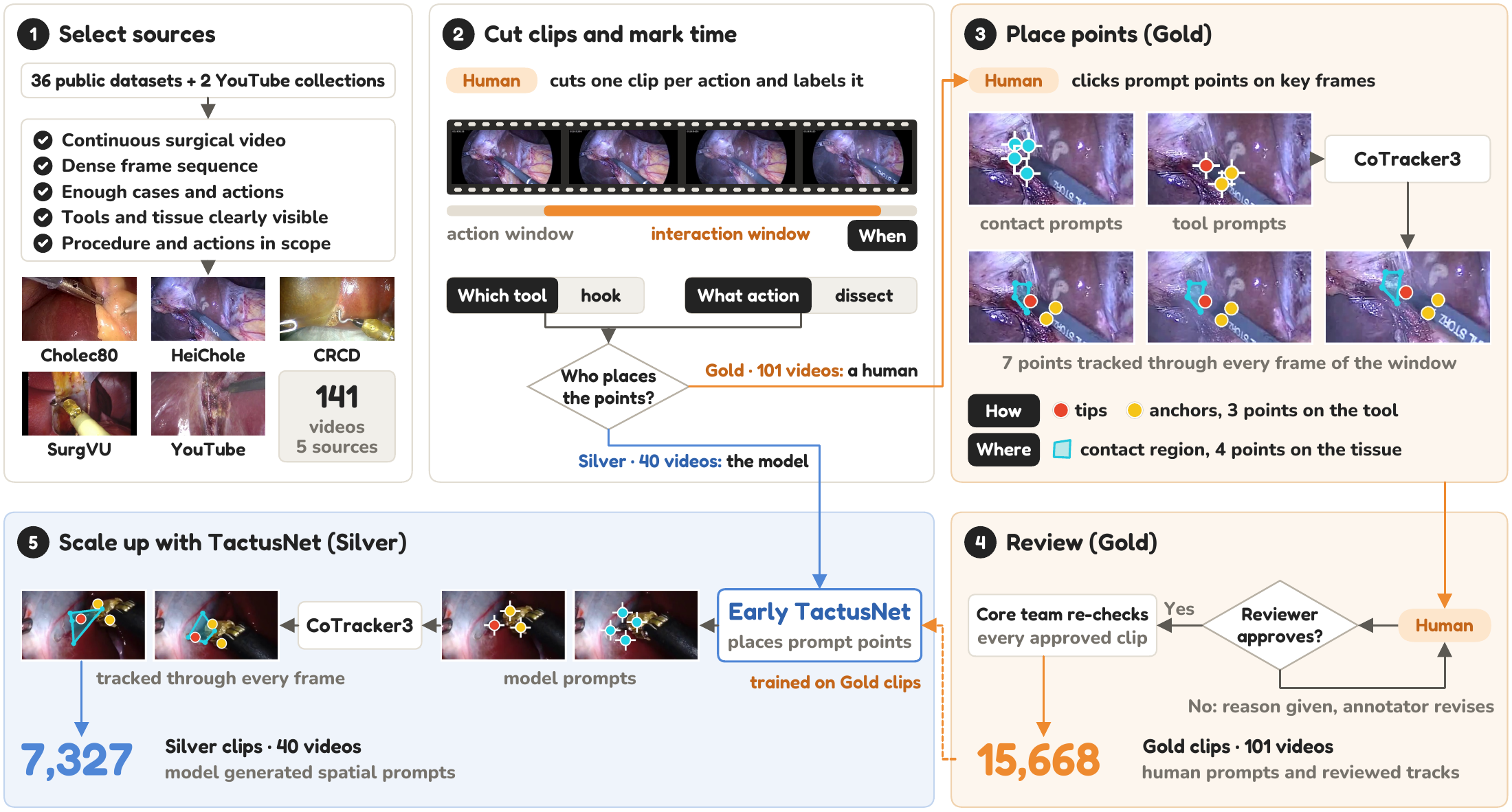
To construct these annotations at scale, we develop a two-tier pipeline combining human annotation, point tracking, and model-generated spatial prompts. Using this pipeline, we re-annotate 141 videos from five public sources, producing 22,995 action clips spanning 2.9 million frames. The dataset comprises 15,668 Gold clips with human spatial prompts followed by review and re-checking, and 7,327 Silver clips combining human semantic and temporal annotations with model-generated spatial prompts.
We further introduce TactusNet, the companion reference network, to benchmark semantic, temporal, and spatial prediction from shared video features. Across TactusNet and 13 published baselines, tool–action accuracy reaches 95.8% with per-head encoder fine-tuning, while the best temporal recall and contact Dice reach 46.6% at temporal IoU 0.7 and 0.351, respectively. Moreover, adding Silver improves the default TactusNet’s pair accuracy from 93.8% to 95.5%. Together, these contributions establish a foundation for learning and evaluating the instrument–tissue interactions underlying future surgical automation.

01
Which instrument acts? One of four tools: hook, grasper, scissors, or clipper.
02
What does it do? One of four actions: dissect, grasp, clip, or cut.
03
An interaction window inside the full action window, which also includes approach and completion.
04
Three instrument-specific landmarks tracked across the action window, with per-frame visibility.
05
Four tissue-point tracks enclosing the affected region, also with per-frame visibility.
Each clip follows one surgical action or attempt. The release covers six tool–action pairs from five public video sources.
| Tool–action pair | Clips | Share |
|---|---|---|
| Hook–dissect | 13,729 | 59.7% |
| Grasper–grasp | 4,228 | 18.4% |
| Scissors–dissect | 2,338 | 10.2% |
| Grasper–dissect | 1,479 | 6.4% |
| Clipper–clip | 618 | 2.7% |
| Scissors–cut | 603 | 2.6% |
| Source | Gold videos | Gold clips | Silver videos | Silver clips |
|---|---|---|---|---|
| Cholec80 | 30 | 6,058 | — | — |
| SurgVU | 32 | 4,281 | 40 | 7,327 |
| YouTube | 21 | 2,766 | — | — |
| HeiChole | 10 | 1,799 | — | — |
| CRCD | 8 | 764 | — | — |
| Source | Tier | Hook dissect | Grasper grasp | Scissors dissect | Grasper dissect | Clipper clip | Scissors cut |
|---|---|---|---|---|---|---|---|
| Cholec80 | Gold | 4,739 | 933 | 12 | 43 | 186 | 145 |
| SurgVU | Gold | 2,688 | 799 | 350 | 296 | 99 | 49 |
| SurgVU | Silver | 3,279 | 1,454 | 1,666 | 546 | 121 | 261 |
| YouTube | Gold | 1,286 | 584 | 209 | 493 | 125 | 69 |
| HeiChole | Gold | 1,109 | 322 | 101 | 101 | 87 | 79 |
| CRCD | Gold | 628 | 136 | — | — | — | — |
| Instrument | Tool tip | Tool anchor | Contact |
|---|---|---|---|
| Hook | 76% | 71% | 94% |
| Grasper | 47% | 65% | 90% |
| Scissors | 64% | 73% | 94% |
| Clipper | 42% | 56% | 82% |
Gold Silver Histograms are normalized within each tier.

Gold · 15,668 clips · 101 videos
Human annotators label the tool, action, and time windows and place spatial prompts. Point tracking is followed by review and a final re-check.
Silver · 7,327 clips · 40 videos
Human annotators label the tool, action, and time windows. A model places spatial prompts for tracking on additional SurgVU clips.

Stage I
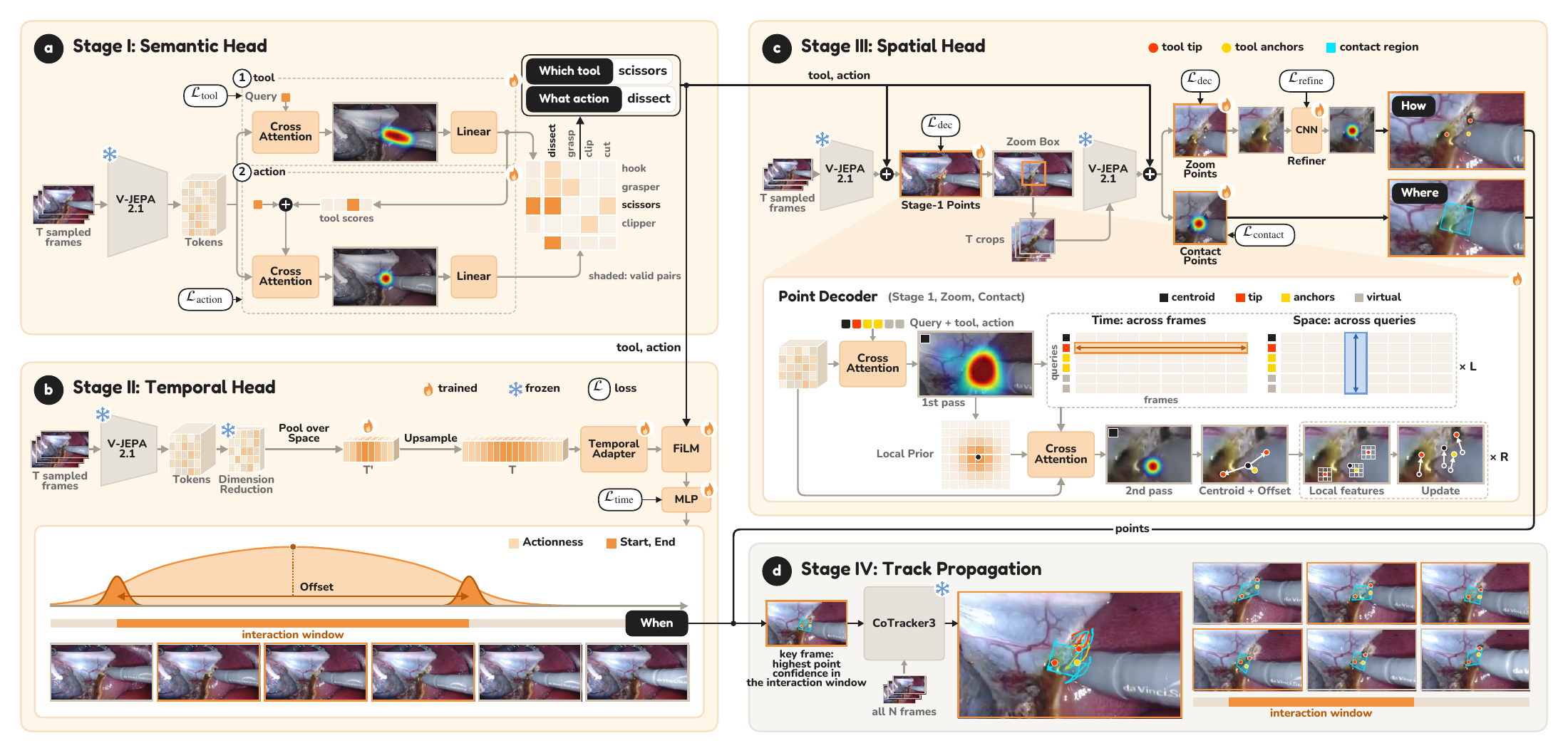
The instrument and action, decoded as one of the six valid tool–action pairs.
Stage II
The start and end of the interaction window within the action window.
Stage III
TactusNet first locates the tool on each full frame and crops around its landmarks. Separate decoders predict three tool landmarks and four contact-region corners in the crop. A final pass refines the tool landmarks at native resolution.
Stage IV
For dense annotation, TactusNet selects the most confident frame within the interaction window separately for tool points and contact corners. CoTracker3 tracks each group through the full action window.
TactusNet · Gold test set
Filled points and the cyan tissue region show the model’s predictions. White rings and the dashed outline show the human annotations.
15,499 Gold clips from 101 videos.
| Tool–action pair | Clips | Share |
|---|---|---|
| Hook–dissect | 1,041 | 68.4% |
| Grasper–grasp | 258 | 16.9% |
| Grasper–dissect | 88 | 5.8% |
| Scissors–dissect | 46 | 3.0% |
| Scissors–cut | 33 | 2.2% |
| Clipper–clip | 57 | 3.7% |
| Method | Backbone | Which ↑ | What ↑ | Pair ↑ | Pair mAcc ↑ |
|---|---|---|---|---|---|
| Majority class | / | 68.4 | 77.2 | 68.4 | 16.7 |
| TSN | ResNet-50 | 84.7 | 81.4 | 78.4 | 56.3 |
| TSM | ResNet-50 | 87.8 | 90.3 | 85.1 | 56.5 |
| VideoMAE | ViT-B/16 | 94.2 | 96.2 | 92.8 | 73.3 |
| X-CLIP | ViT-B/16 | 91.3 | 90.6 | 87.1 | 68.7 |
| Endo-FM | ViT-B/16 | 85.1 | 82.9 | 80.0 | 42.5 |
| TactusNet | ViT-L/16, frozen | 96.3 | 96.5 | 93.8 | 82.7 |
| TactusNet, fine-tuned (shared) | ViT-L/16 | 96.3 | 96.9 | 94.1 | 84.9 |
| TactusNet, fine-tuned (per head) | 3 × ViT-L/16 | 97.6 | 97.8 | 95.8 | 89.2 |
| Method | Backbone | tIoU ↑ | R@0.7 ↑ |
|---|---|---|---|
| Whole window | / | 0.454 | 15.4 |
| Pair-mean interval | / | 0.569 | 36.1 |
| ActionFormer | ViT-L/16, frozen | 0.624 | 46.6 |
| TriDet | ViT-L/16, frozen | 0.616 | 45.5 |
| QD-DETR | ViT-L/16, frozen | 0.599 | 44.3 |
| MS-TCN | ViT-L/16, frozen | 0.607 | 43.3 |
| TactusNet | ViT-L/16, frozen | 0.592 | 40.7 |
| TactusNet, fine-tuned (shared) | ViT-L/16 | 0.592 | 40.8 |
| TactusNet, fine-tuned (per head) | 3 × ViT-L/16 | 0.592 | 40.4 |
| Method | Backbone | ADE (px) ↓ | >32 px ↓ | Dice ↑ |
|---|---|---|---|---|
| DARK | HRNet-W32 | 23.88 | 24.4 | 0.347 |
| ViTPose | ViT-B/16 | 23.64 | 24.0 | 0.339 |
| DSTA | ResNet-50 | 25.70 | 25.2 | 0.312 |
| SegFormer | MiT-B2 | – | – | 0.351 |
| TactusNet | ViT-L/16, frozen | 19.15 | 20.3 | 0.242 |
| TactusNet, fine-tuned (shared) | ViT-L/16 | 19.10 | 20.3 | 0.244 |
| TactusNet, fine-tuned (per head) | 3 × ViT-L/16 | 18.68 | 19.9 | 0.244 |
Shaded rows show TactusNet variants. Orange squares mark the best score in each column (↑ higher is better, ↓ lower is better).
@article{wang2026tactus,
title = {TACTUS: Unifying Surgical Action Understanding in Time and Space},
author = {Wang, Lurui and Ding, Hao and Yu, Chenhao and Jing, Chenyan and Xu, Jiru and Zuo, Ruoqi and Mei, Liwei and Liu, Chang and Seenivasan, Lalithkumar and Unberath, Mathias},
year = {2026}
}